What makes certain tubes sound "better"?

beckstriad

Administrator
Staff member
I have zero knowledge of circuit design. This has always been a curiosity to me.

I seem to have always preferred, for instance, 6V6 to EL84 tubes and 6L6 to EL34 tubes. Others may be just the opposite. What is about circuit design that makes one favor one tube over the other, or certain builders favoring a specific preamp/power tube complement over others?

I acknowledge that this may also be the wrong question entirely, or a question to which a straightforward answer cannot be given. I am always happy to be wrong and learn. Philosophizing or explanation would be great!
 
I don’t think it’s specifically tubes. I think it’s the circuit and the VOLTAGE applied to those tubes. The reason why NOS tubes “Sound better” is because of the voltage and their ability to handle that voltage.
Of course there are other components the play a roll in that equation. However, my experience is to many folks focus on the preamp of circuits and their tubes. When actually it’s the power section they are hearing. At least for the qualities you and I are looking for.

I don’t want compression and blocking distortion. I want harmonics, controlled feedback and balanced signal at output.
 
Yeah, I'm not very knowledgeable about tube construction and why some sound and perform better. Mike at Komet is really knowledgeable about tubes, but he's in the biz.

Sometimes I can't hear much of a difference on the preamp tubes and other times I can really hear a difference. I have a ton of NOS preamp tubes. Power amp tubes can really be different too, like Rob said. I like to somewhat crank my amps and that's when you can tell if a tube is letting all the frequencies and harmonics out or if they are squashed.
 
EL84 and EL34 are Euro tubes. 6V6 and 6L6 are US tubes. Europe uses a different voltage/frequency than US.

I had thought “chime” was an inherent characteristic of EL84 amps. A builder friend then let me play an EL84 Traynor (not sure which) that he had. It was one of the darkest amps I have ever played. Chime was NOT a factor.

Many know this, but just for grins, it has always helped my thinking to consider tubes as valves. I like that analogy, but still call them tubes. If you think about how they work, they are indeed valves for electric current flow. Some valves are capable of very high precision controlled flow, depending on the supporting circuitry, while others spew everywhere when barely turned on, basically acting like an on/off switch (valve). Diodes (rectifier, 5U4, etc) are basically one-way streets. Triodes (12AX7, et al) are simple valves where the current flow can be controlled by a small modulated signal applied to an internal grid (thus, amplification). Pentodes have additional grids for smoothing, dampening, etc. There are also tubes that are totally unsuited for audio purposes. This is why you resist buying an old TV repair kit. There may be two tubes in there you can use.

Not going on another incoherent oratory today, so I’ll stop here. For now.
 
Yeah, I'm not very knowledgeable about tube construction and why some sound and perform better. Mike at Komet is really knowledgeable about tubes, but he's in the biz.

Sometimes I can't hear much of a difference on the preamp tubes and other times I can really hear a difference. I have a ton of NOS preamp tubes. Power amp tubes can really be different too, like Rob said. I like to somewhat crank my amps and that's when you can tell if a tube is letting all the frequencies and harmonics out or if they are squashed.
I once bought an Epiphone Valve Jr just to experiment with. You can tell night and day differences between preamp tubes in that little amp. I only had a stash of American tubes, but the difference was as stated. A Sylvania 12AX7 was the clear winner in that group. Various RCA were next.
 
EL84 and EL34 are Euro tubes. 6V6 and 6L6 are US tubes. Europe uses a different voltage/frequency than US.

I had thought “chime” was an inherent characteristic of EL84 amps. A builder friend then let me play an EL84 Traynor (not sure which) that he had. It was one of the darkest amps I have ever played. Chime was NOT a factor.

Many know this, but just for grins, it has always helped my thinking to consider tubes as valves. I like that analogy, but still call them tubes. If you think about how they work, they are indeed valves for electric current flow. Some valves are capable of very high precision controlled flow, depending on the supporting circuitry, while others spew everywhere when barely turned on, basically acting like an on/off switch (valve). Diodes (rectifier, 5U4, etc) are basically one-way streets. Triodes (12AX7, et al) are simple valves where the current flow can be controlled by a small modulated signal applied to an internal grid (thus, amplification). Pentodes have additional grids for smoothing, dampening, etc. There are also tubes that are totally unsuited for audio purposes. This is why you resist buying an old TV repair kit. There may be two tubes in there you can use.

Not going on another incoherent oratory today, so I’ll stop here. For now.

That’s fascinating. I truly know nothing about any of this stuff. All very interesting to me, and I appreciate you sharing.
 
Good question.
As Rob said, to me the overall circuit & components that surround the "tubes" are at least as much, if not more than the tubes themselves, contributing to the final end result (= sound & feel) we can experience in a tube amp as a player.
Its a whole to me, each tube within a given circuit and physical environment.

Tubes, especially audio ones we know in guitar amps, are quite simple concept at the high level, and not that "complicated" assemblies when you look at them (ie: in number / type of parts); yet the tiniest details in how each of their parts are designed & manufactured, then assembled, can impact their functional characteristics, how they will interact with the circuit they are in and the overall environment.
Those different functional characteristics, between types, or even brands/models etc., related to how the tube will interact with its outside world, often call for different circuit & related component design characteristics to best use each different tube. And/or the designer can also design some of the related circuit / components around the tube with a particular end result in mind.
Good to note as well that audio tubes are very "mechanical" devices at their heart, meaning they and their function can be affected by the environment beyond the pure "electrical" one in the circuit (ex: mechanical like vibrations, heat...).

I feel that the simpler the amp design/circuit (ex: classic old single channel vintage amps), the more the player can experience & feel the effects of the variations in each of those "tube ecosystems"; that being changing tubes types/model/brand in the same amp, or playing different amps designed around different tube types.

If I then digress to some lyrical motorsport analogy, I could see tubes, especially the power ones, like the engine block of a combustion engine & its internal mechanical components in a car:
the type of engine architecture, and how it is designed & manufactured, can by itself produce different results (performance, sound...);
yet the engine block itself can do nothing for one to drive around without the rest of the chain from the power train to the road related circuit/components, and even its performance/sound can be impacted by all that chain: from the air + fuel supply system (power supply), to the gearbox (output transformer), suspension (cab) and tires (speakers).
You experience the whole system when you have fun driving your old sport car.

Hope that makes sense.
 
Yes fully agree GAT.
Linked to that I also think some could be said about those simpler circuits / designs being able to provide a level of player dynamic interaction that I've hardly ever found in more "complex" amps.
 
I agree with all thats been shared about circuits and the role tubes play in them. I started off in the realm of channel-switchers and have since moved to simpler (i.e. - more “pure”) amp circuits. The response to tube changes is much more pronounced in terms of tone, touch response and feel in those pure circuits. Like @beckstriad, I tend to favor 6V6, 6L6 - and would add KT66’s and KT88’s into the mix - in the power section… they seem to be what my ears respond to. I do think it’s critical to any given circuit that the tubes used are quality, in-spec ones. There are a lot of tubes out there that don’t pass “the test”, so to speak and won’t give optimal results and interactive joy with your rig.
 
I agree with all thats been shared about circuits and the role tubes play in them. I started off in the realm of channel-switchers and have since moved to simpler (i.e. - more “pure”) amp circuits. The response to tube changes is much more pronounced in terms of tone, touch response and feel in those pure circuits. Like @beckstriad, I tend to favor 6V6, 6L6 - and would add KT66’s and KT88’s into the mix - in the power section… they seem to be what my ears respond to. I do think it’s critical to any given circuit that the tubes used are quality, in-spec ones. There are a lot of tubes out there that don’t pass “the test”, so to speak and won’t give optimal results and interactive joy with your rig.

I think KT66s are my favorite overall tube. Perfect for what I want to feel and hear.
 
I found that tubes are also a personal taste thing.
I never really warmed up to EL 84s amps, love 6V6 and 6L6 amps.When it comes to 6L6's it seems I really love the Tungsol 5881. Not the reissues the real US made Tungsol's from the 50's.
The last week I played around with the tubes on my '65 Super Reverb, it had Sylvania's 6L6GC installed when I bought it. They sounded great, but they got old and tired. I have 2 pairs of the original Sventlana 6L6GC from the late 90's, never installed them anywhere. Well, I put in the SR and very much loved the tone. A few days ago, I went through my tubes collection and I have quite a few pairs NOS 5881's. The plate voltage on my SR reads 448V, I thought well let's try the 5881.
These are the ones which will stay, it sounds warm but not muddy, it took a little edge off the trebles (which is not bad in a SR). Since I am a clean player I bias on the cold side. To me the 65 SR (ceramic CTS) never sounded that good. No I have to try a pair in my '66 SR (AlNiCo CTS).
I also have the 5881's my RockPhonics Bandmaster since years and no problems. So it seems these old Tungsols have no issue with the higher as rated PV.
 
I found that tubes are also a personal taste thing.
I never really warmed up to EL 84s amps, love 6V6 and 6L6 amps.When it comes to 6L6's it seems I really love the Tungsol 5881. Not the reissues the real US made Tungsol's from the 50's.
The last week I played around with the tubes on my '65 Super Reverb, it had Sylvania's 6L6GC installed when I bought it. They sounded great, but they got old and tired. I have 2 pairs of the original Sventlana 6L6GC from the late 90's, never installed them anywhere. Well, I put in the SR and very much loved the tone. A few days ago, I went through my tubes collection and I have quite a few pairs NOS 5881's. The plate voltage on my SR reads 448V, I thought well let's try the 5881.
These are the ones which will stay, it sounds warm but not muddy, it took a little edge off the trebles (which is not bad in a SR). Since I am a clean player I bias on the cold side. To me the 65 SR (ceramic CTS) never sounded that good. No I have to try a pair in my '66 SR (AlNiCo CTS).
I also have the 5881's my RockPhonics Bandmaster since years and no problems. So it seems these old Tungsols have no issue with the higher as rated PV.

I'm with you and feel pretty much the same. The only EL84 amps I've played where I felt like they fit with what I wanted were the Komet Constellation, Budda Stringmaster, and Bruno Underground.

The rest are 6V6, 6L6, and KT66 almost exclusively. My Budda Superdrive has 5881s and they sound great, as does my Bruno Lead Man.
 
Yes, as with most things it comes down to personal taste.
And again it's more about the overall "system" than just the type of tube IMHO.
A good old 60's Vox AC30 (or even 15) is a thing of beauty to me, even if I'm more of a "big amp" (with EL34/6L6/KT88...) guy by default.
 
I played a Traynor amp once that contained EL84s. It was a very dark sounding amp. I didn’t expect that, having erroneously associated those tubes solely with bright sparkly sounding amps. Therefore, it’s the circuit. But my current favorite amps have 6v6 (Kelley) and EL84 (Connie) and EL34 (LE Cobra) Therefore, it’s the toobs.

Wait…
 
Last edited:
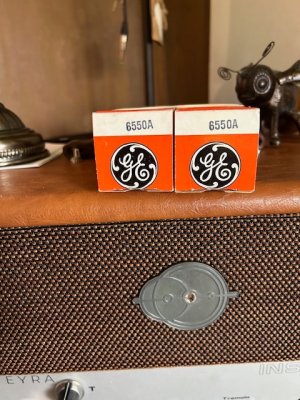
I’m also a 6L6 / 6V6 fan. Most of the amps I have owned are one or the other ( including 5881). Today I installed a set of 6550a in my AE Instigator and I was blown away. Made the amp fuller sounding with more clarity on the high end.
IMG_8477.jpeg
 
I’m also a 6L6 / 6V6 fan. Most of the amps I have owned are one or the other ( including 5881). Today I installed a set of 6550a in my AE Instigator and I was blown away. Made the amp fuller sounding with more clarity on the high end.
View attachment 10

will you post some clips when you can of the instigator? I haven't heard many of them.
 
Back
Top